DepEd Just Called AI Grading "High-Risk." Here's What That Actually Requires.
The fine print behind DepEd's AI grading rule


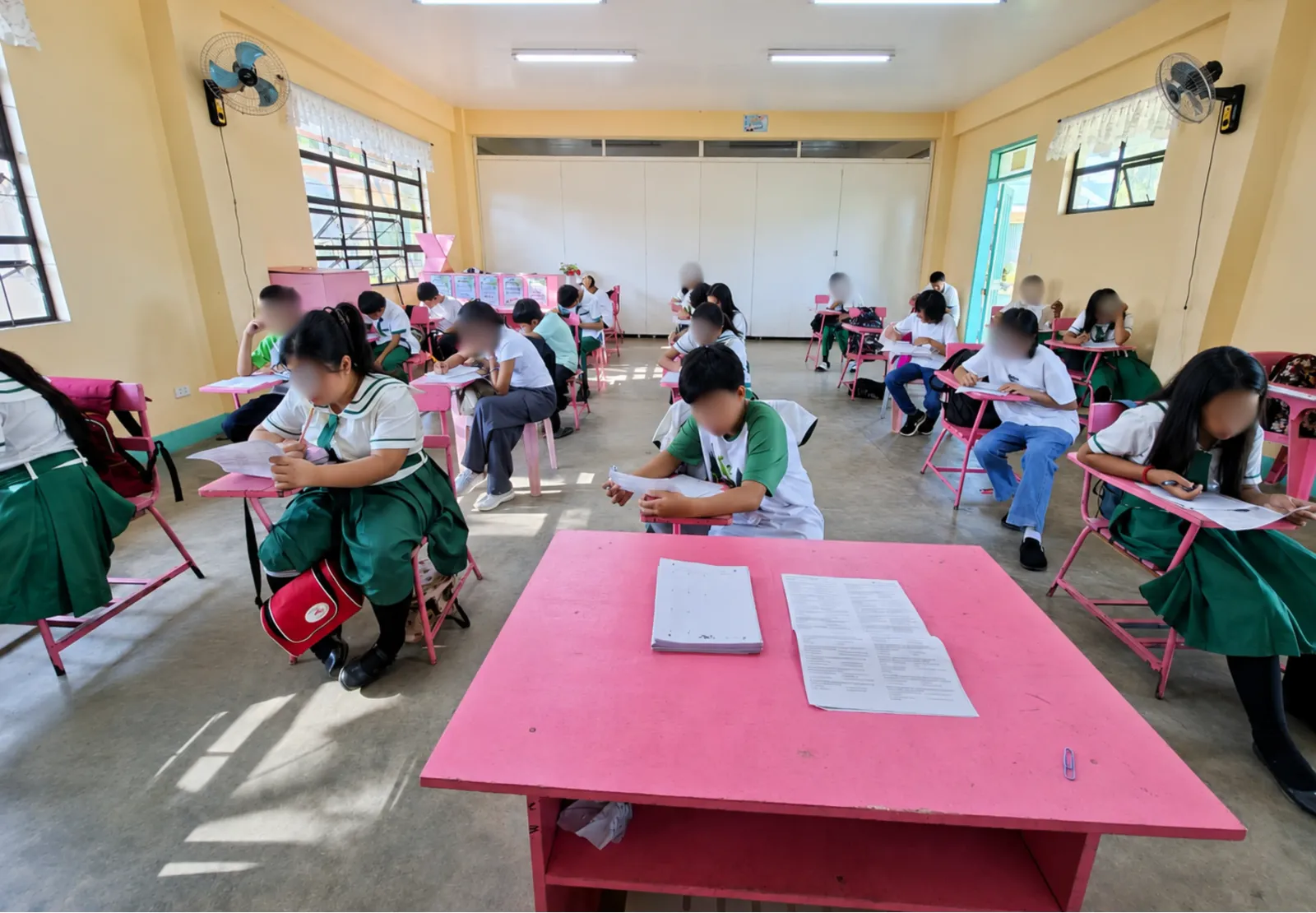
Throughout 2025, Philippine schools largely handled AI on their own, with individual teachers and administrators making their own calls in the absence of a national policy. That changed in February 2026, when the Department of Education issued its first formal guidelines on the subject.
Department Order No. 003, series of 2026, the Foundational Guidelines on Artificial Intelligence in Basic Education, is a 49-page document that spells out how AI is allowed to be used in Filipino classrooms. Signed by Education Secretary Sonny Angara and dated February 20, 2026, it doesn't ban AI, but it does set limits. One detail worth noting for anyone working in a school: the order classifies AI tools used for grading as "high-risk."
Why "High-Risk" Isn't the Same as "Banned"
It's easy to read "high-risk" and assume the department is slamming the door on AI-assisted grading. That's not quite what's happening.
Angara was blunt about the reason the order exists at all. AI use in classrooms, he said, had "outpaced the ability of the basic education system to put in place clear, unified and enforceable policies." He also pointed to the absence, until now, of a national framework aligned with existing laws on data privacy, content accuracy, and sound pedagogy, something that had left teachers and learners relying on "informal and inconsistent practices."
The order draws its line around a specific concern: letting AI make decisions that affect a learner's rights, outcomes, or records without a person checking the work. Under DO 003's risk classification, AI applications used for grading, admissions, scholarships, and disciplinary actions are grouped together as "high-risk" and "must only be permitted under strict safeguards and human oversight." Lower on the scale, tools like chatbots for administrative queries, spam filters, and grammar checkers fall under "limited to minimal risk."
Angara was direct about the intent in a follow-up interview: "There's an ethical use of AI. Hindi naman natin ipagbabawal ang AI (We will not prohibit the use of AI)." Teachers are asked to use AI responsibly, meaning they still do the actual grading themselves, rather than letting an AI tool grade in their place.
In other words: the department isn't saying AI has no place near a grade. It's saying a grade can't come out of a black box. A teacher has to be the one who actually decides.
A Policy That's Building, Not Just Restricting
It would be easy to read DO 003 as purely defensive if it existed in isolation. It doesn't.
Weeks earlier, on January 9, 2026, President Ferdinand Marcos Jr. himself launched DepEd's Project AGAP.AI, short for Accelerating Governance and Adaptive Pedagogy through Artificial Intelligence, DepEd's flagship response to AI's rapid arrival in classrooms. Alongside it, DepEd announced a national AI skills training program built with the ASEAN Foundation and Google.org, targeting up to 1.5 million participants nationwide: 1.05 million learners, 300,000 teachers, and 150,000 parents, rolled out in phases through 2026.
Put the training rollout and the risk-classification order side by side, and a clearer picture forms. DepEd isn't trying to keep AI out of Philippine classrooms. It's trying to make sure that wherever AI shows up, a teacher's judgment is still the thing a grade, a decision, or a learner's record actually rests on.
What "High-Risk, But Allowed" Looks Like in Practice
For a teacher facing a stack of papers on a Friday afternoon, this distinction isn't abstract. It's the difference between a tool that quietly replaces the grading decision and one that simply makes the decision faster to reach.
AI can speed up the mechanical parts of grading: checking answer patterns, surfacing how the whole class performed on a given item, flagging what might need a second look. What it can't do, under this order, is skip the teacher and hand a final score straight to a student.
This is, in practice, exactly the model GradeChum is built around. It scans handwritten answer sheets and helps a teacher move through grading faster, but every score still passes through the teacher before it is final. The class performance data it surfaces is meant to inform a teacher's judgment, not substitute for it. In a policy environment that classifies AI grading as high-risk specifically because it worries about decisions being made without a human in the loop, that alignment isn't a coincidence. It's the design constraint the whole category was always going to need.
This came up in the first episode of GradeChum's AI EduTalk series, where the GradeChum CEO and Founder Mr. Jemar Jude Maranga introduced the "hamburger method": prompt setup on top, AI-generated output in the middle, and teacher review and verification on the bottom, the layer that actually finalizes a grade. Consequently, Engr. Cheradee Ann Cabanlit, the guest of this episode, summed it up in three words: "AI-assisted, human-verified." Skip that bottom layer, and the decision is effectively made by a machine alone, exactly what DO 003 is meant to prevent.
The Real Takeaway
DO 003 isn't the end of the AI-in-schools conversation in the Philippines. It's closer to the opening move in one that's going to keep evolving, especially as more tools built specifically for grading and assessment start reaching Filipino classrooms.
What the order makes clear, though, is the shape any of those tools will need to take to actually work here. Not AI that replaces a teacher's judgment, but AI that respects how much that judgment still matters, and gets out of the way once the teacher has the information they need to make the call themselves.
That's the takeaway worth sitting with if you're evaluating any AI tool for your school: the ones worth trusting are the ones that were never trying to replace you in the first place. GradeChum was built around that same premise well before DO 003 existed, assisting teachers with the mechanical side of grading while leaving the actual judgment, the final score, and the feedback a student receives squarely in the teacher's hands. That's not a workaround to stay compliant with a new policy. It's the same principle DO 003 is now asking every AI tool in a Filipino classroom to follow.